


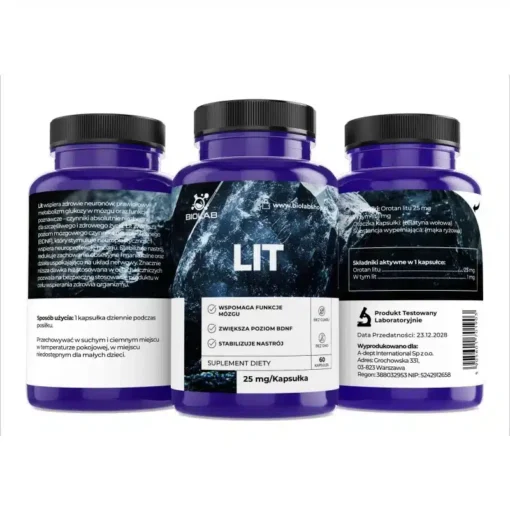

Litio 25 mg, 60 capsule
35,32 €
Lithium is a key micronutrient that helps stabilize mood, supports mental health, en biedt neuroprotectie.
- Beschrijving
- Beoordelingen (0)
Beschrijving
Lithium – A Micronutrient for Mood Balance and Tranquility
Lithium is a natural mineral that plays an important role in mental health and various physiological processes.
Kenmerken:
- Mood Stabilization: Balances mood swings.
- Mental Health Support: Alleviates depression and anxiety.
- Neuroprotectie: Protects brain cells from degeneration.
- Neuroplasticity Enhancement: Improves learning and memory.
- Suicide Risk Reduction: Lowers tendencies toward suicide.
- Hormonale regulatie: Modulates endocrine function.
- Ontstekingsremmende effecten: Reduces chronic inflammation.
- Serotonin Increase: Boosts neurotransmitters that regulate mood.
- Neuropathic Pain Relief: Eases chronic pain.
- Cardiovascular Benefits: Potentially protects heart health.
1. Mood Stabilization
Lithium is well-known for its effectiveness in stabilizing mood and treating bipolar disorder. It helps manage mood swings by moderating neurotransmitter levels in the brain, thereby reducing the frequency and intensity of manic and depressive episodes.
2. Mental Health Support
In addition to bipolar disorder, lithium is used to treat major depressive disorder and anxiety disorders. It can help alleviate depressive symptoms and promote emotional stability, contributing to the overall improvement of mental health.
3. Neuroprotective Effects
Research shows that lithium possesses neuroprotective properties that may help prevent neurodegenerative diseases such as Alzheimer’s and Parkinson’s disease. Its ability to protect neuronal cells supports cognitive health and may help slow the progression of these diseases.
4. Enhancing Brain Plasticity
Lithium is believed to enhance neuroplasticity, which is the brain’s ability to reorganize itself by forming new neural connections. This is particularly beneficial for learning and memory and makes lithium an important factor in cognitive development and rehabilitation.
5. Suicide Risk Reduction
Several studies have demonstrated that lithium treatment significantly reduces the incidence of suicide among individuals with mood disorders. This makes lithium a key component of treatment plans aimed at improving the quality of life for those at risk.
6. Hormonal Regulation
Lithium influences several hormonal pathways, including the secretion of thyroid hormones. By helping regulate endocrine function, lithium may contribute to metabolic balance and overall health.
7. Anti-Inflammatory Properties
Lithium exhibits anti-inflammatory effects that can benefit those suffering from chronic inflammation. By reducing inflammation, it can promote various aspects of health and well-being.
8. Increases Serotonin Levels
Research suggests that lithium can promote increased levels of serotonin in the brain, a neurotransmitter that is crucial for mood regulation. Higher serotonin levels are often associated with improved mood and reduced anxiety.
9. Support in Neuropathic Pain
Emerging research indicates that lithium may have analgesic properties that could contribute to the relief of neuropathic pain. Its pain modulation potential makes it a candidate for further exploration in pain treatment.
10. Potential Cardiovascular Benefits
Preliminary studies suggest that lithium may have a protective effect on cardiovascular health, possibly reducing the risk of cardiovascular diseases. Further research is needed to fully understand its effects on heart health.
Dosage and Monitoring:
It is essential to regularly monitor lithium levels to avoid potential side effects and ensure the safety of treatment. The appropriate dosage of lithium can vary based on individual requirements, and it should be determined by a healthcare professional. Standard therapeutic doses typically range from 900 to 1200 mg per day, divided into doses (though specific recommendations may vary based on individual needs and circumstances).
Inhoud:
– Actief ingrediënt: Lithium (as Lithium Carbonate or other forms)
– Excipient Ingredients: May include binders, fillers, and coatings (specific excipients depend on the manufacturer and formulation).
– Formulering: Usually available in tablet or capsule form for oral administration.
Consult with a healthcare provider before starting lithium supplementation, as it can interact with other medications and may not be suitable for everyone. Regular blood tests are necessary to monitor levels and ensure safety throughout the treatment process.
- Lithium:
-
Malhi, G. S., & Berk, M. (2019). “Lithium: The Good, the Bad and the Ugly.” Australian & New Zealand Journal of Psychiatry, 53(10), 885-886. DOI: 10.1177/0004867419866850
-
Rhodiola-roos:
-
Panossian, A., & Wikman, G. (2010). “Effects of adaptogens on the central nervous system and the molecular mechanisms associated with their stress—protective activity.” Psychological Medicine, 40(10), 1593-1600. DOI: 10.1017/S0033291710000142
-
L-theanine:
-
Ritsner, M. S. (2009). “The role of L-theanine in treating stress.” Stress and Health, 25(2), 157-165. DOI: 10.1002/smi.1230
-
Omega-3 Fatty Acids:
-
O’Brien, S. M., & Baghai, T. (2006). “Omega-3 Fatty Acids in the Treatment of Major Depression and Bipolar Disorder.” European Psychiatry, 21(5), 359-364. DOI: 10.1016/j.eurpsy.2006.04.012
-
Magnesium:
-
Barbagallo, M., & Dominguez, L. J. (2010). “Magnesium and aging.” Huidig farmaceutisch ontwerp, 16(7), 832-839. DOI: 10.2174/138920110790846638
-
Vitamine D:
-
Holick, M. F. (2007). “Vitamin D Deficiency.” New England Tijdschrift voor Geneeskunde, 357(3), 266-281. DOI: 10.1056/NEJMra070553
-
Vitamine B6:
- McCormick, D. B. (1992). “Vitamin B6.” Kritische recensies in voedingswetenschap en voeding, 32(1), 1-24. DOI: 10.1080/10408399209527598
Wees de eerste om “Litio 25 mg, 60 capsule” te beoordelen
Gerelateerde producten
-
00-BS, BESTE BOOSTER, MASSA OMHOOG, SPIEROPBOUWERS, VOEDING, BCAA/EAA, VOOR DE WORKOUT, STIM-VRIJE PREWORKOUTS
Nasleep 312,5g
38,40 €Dit product heeft meerdere variaties. Deze optie kan gekozen worden op de productpaginaSnel bekijken -
00-BS, BESTE BOOSTER, MASSA OMHOOG, SPIEROPBOUWERS, VOEDING, BCAA/EAA, VOOR DE WORKOUT, STIM-VRIJE PREWORKOUTS
BULK XXL BCAA 400g
19,20 €Dit product heeft meerdere variaties. Deze optie kan gekozen worden op de productpaginaSnel bekijken -
00-BS, BESTE BOOSTER, MASSA OMHOOG, SPIEROPBOUWERS, VOEDING, BCAA/EAA, VOOR DE WORKOUT, STIM-VRIJE PREWORKOUTS
Levrone Anabole ICE BCAA 375g
24,00 €Dit product heeft meerdere variaties. Deze optie kan gekozen worden op de productpaginaSnel bekijken -
00-BS, BESTE BOOSTER, MASSA OMHOOG, SPIEROPBOUWERS, VOEDING, BCAA/EAA, VOOR DE WORKOUT, STIM-VRIJE PREWORKOUTS
MuscleSport BCAA Revolutie 450g
42,00 €Dit product heeft meerdere variaties. Deze optie kan gekozen worden op de productpaginaSnel bekijken -
00-BS, BESTE BOOSTER, MASSA OMHOOG, SPIEROPBOUWERS, VOEDING, BCAA/EAA, VOOR DE WORKOUT, STIM-VRIJE PREWORKOUTS
Sarma-Com Nitro-9 EAA 321g
52,80 €Dit product heeft meerdere variaties. Deze optie kan gekozen worden op de productpaginaSnel bekijken
 Nederlands
  English (UK)
  Italiano
  Español
  Deutsch
  Français
  Magyar
  Čeština
  Polski
Beoordelingen
Er zijn nog geen beoordelingen.